

Clinical skin treatments worth the cost
Table of Contents
- What clinical skin treatments actually do
- Clinical treatments vs at-home skincare: where the difference shows
- Professional skin treatment costs: what you're paying for
- How long do skin treatment results last
- Treatment options by skin concern
- What to expect during and after treatment
- Questions to ask before a skin treatment
- Is clinical skin treatment worth your investment
- Frequently Asked Questions
Last Updated: October 10, 2026
What clinical skin treatments actually do
Clinical skin treatments are professional procedures that stimulate cellular renewal and deliver active ingredients deep into the skin, addressing concerns that at-home products cannot reach. (Source: Australian Competition and Consumer Commission (ACCC) guidelines on advertising)
A clinical facial uses medical-grade actives, peptides, advanced chemical peels, or skin needling applied by a qualified practitioner who adjusts treatment in real time. These penetrate beyond the surface, triggering collagen production and evening tone and texture in ways topical creams cannot.
Your skin barrier stops most at-home products from doing meaningful work. Clinical treatments bypass that limitation.
Clinical treatments vs at-home skincare: where the difference shows
At-home skincare maintains skin health; clinical treatments transform it. A retinol serum at home contains a lower concentration of active ingredient, while a clinical peel contains a higher concentration, applied under professional supervision.
Clinical treatments trigger visible cell turnover, fade pigmentation, and build collagen within weeks, results that take months or don't happen at all with topical products. Stubborn acne scars, deep lines, or uneven tone require professional intervention.
Aspect |
At-Home Skincare |
Clinical Treatment |
|---|---|---|
Active concentration |
0.5-5% |
20-70% |
Penetration depth |
Surface layer |
Dermal layer |
Results timeline |
3-6 months |
2-4 weeks |
Customisation |
Limited |
Fully tailored per session |
Downtime |
None |
Minimal to moderate |
A clinical treatment costs more because it delivers results that skincare cannot. The question is whether you're ready to invest in visible change or content with maintenance.
Professional skin treatment costs: what you're paying for
You're paying for skin therapist expertise, pharmaceutical-grade ingredients, professional equipment, and real-time customisation. A qualified skin practitioner layers treatments safely and adjusts intensity based on your skin's response. Equipment like professional-grade LED panels and microneedling devices are expensive to maintain. During treatment, the skin practitioner assesses your skin's response and adjusts, extending peels on pigmented areas or using different needle depths for sensitive zones, separating a generic facial from a transformative one.
Single treatments versus treatment courses
A single Transformation Facial ($329) delivers visible results: immediate glow, smoother texture, softened fine lines. A course of 3 treatments ($885, or $295 per facial) compounds results, collagen accumulates, pigmentation fades progressively, and by session three, clients report transformative change.

Mild acne or early fine lines typically benefit from a course of treatments. Deeper concerns like significant scarring or stubborn pigmentation may require a more extended course.
Value comparison: results per dollar spent
The real cost metric isn't price per treatment. It's cost per visible, lasting result.
A single Essentials Facial at $279 addresses surface concerns and maintains skin health. It's excellent value if your goal is prevention.
The Transformation Facial at $329 delivers measurable change in one session: visible texture improvement, reduced fine lines, evening of tone.
The Transformation Course at $295 per facial is the most cost-effective path to significant results.
The Bright-Lights LED Facial at $179 is the most affordable entry point. LED addresses specific concerns, redness, blemishes, dull tone, without the intensity of peels or needling.
How long do skin treatment results last
A single treatment provides temporary benefits. A course of treatments can lead to more sustained improvements. Many clients book maintenance treatments to sustain results.
LED treatments, chemical peels, and skin needling can produce visible results. Combining modalities, as in the Transformation Facial, can extend results by addressing multiple layers simultaneously.
Treatment options by skin concern
Choosing the right treatment depends on what you're actually trying to fix. The same facial doesn't work for everyone.
Anti-ageing and fine lines
Fine lines and loss of elasticity respond best to treatments that stimulate collagen: skin needling, advanced peptide peels, and LED therapy.
Skin needling (Dermapen) creates controlled micro-injuries that trigger the skin's natural healing response. The Transformation Facial includes Dermapen for the face; the Indulgence Course extends it to the neck and décolletage, areas where ageing shows first.
![The Indulgence Skin Journey Course - 3 Pack $1068 [ $356 p/facial ]](https://cdn.shopify.com/s/files/1/0792/7096/9640/files/INDULGENCE_FACIAL.jpg?v=1697179324)
The Indulgence Skin Journey Course - 3 Pack $1155 [ $385 p/facial ]
Advanced peptide peels work differently. They dissolve the outer layers of dead skin while infusing peptides that signal collagen production. The result is immediate smoothness plus ongoing collagen building.
LED therapy, particularly red and near-infrared wavelengths, stimulates fibroblasts, the cells that produce collagen. The Bright-Lights LED Facial is an excellent, affordable option for ongoing collagen support.
For early fine lines and prevention, a course of LED facials or Essentials Facials works well. For established lines and loss of elasticity, the Transformation or Indulgence course delivers faster, more dramatic results.
Acne, pigmentation, and texture
Acne, post-inflammatory hyperpigmentation, and rough texture respond to chemical peels, extraction, and LED.
Chemical peels dissolve congestion and accelerate cell turnover. Advanced peels (included in Transformation and Indulgence courses) are strong enough to address stubborn breakouts and fade acne scars.
Extraction during a professional facial can help clear congestion. A qualified and trained skin therapist uses proper technique to extract without damaging surrounding skin.
LED therapy, particularly blue wavelengths, has antimicrobial properties that help control acne-causing bacteria (Blue light for infectious diseases).
For pigmentation, sun spots, melasma, post-inflammatory marks, peels and LED are the primary tools. Chemical peels remove the pigmented outer layer.
Texture concerns (roughness, enlarged pores, scarring) respond to skin needling and peels.
Sensitive and reactive skin
Sensitive skin needs gentler treatment and careful modality selection. The Essentials Facial is designed for sensitive skin: it includes options like fruit enzyme peels (gentler than chemical peels), oxygen infusions, microdermabrasion, dermaplanning and hydrating masks.
LED therapy is also excellent for sensitive skin. It calms inflammation, reduces redness, and strengthens the skin barrier without irritation.
If you have reactive skin (rosacea, eczema-prone, easily irritated), a consultation is essential before booking.
The key: sensitive skin shouldn't be neglected. It just needs the right approach. Gentle, consistent professional treatment can help calm reactivity, as a practitioner can monitor and adjust in real time.
What to expect during and after treatment
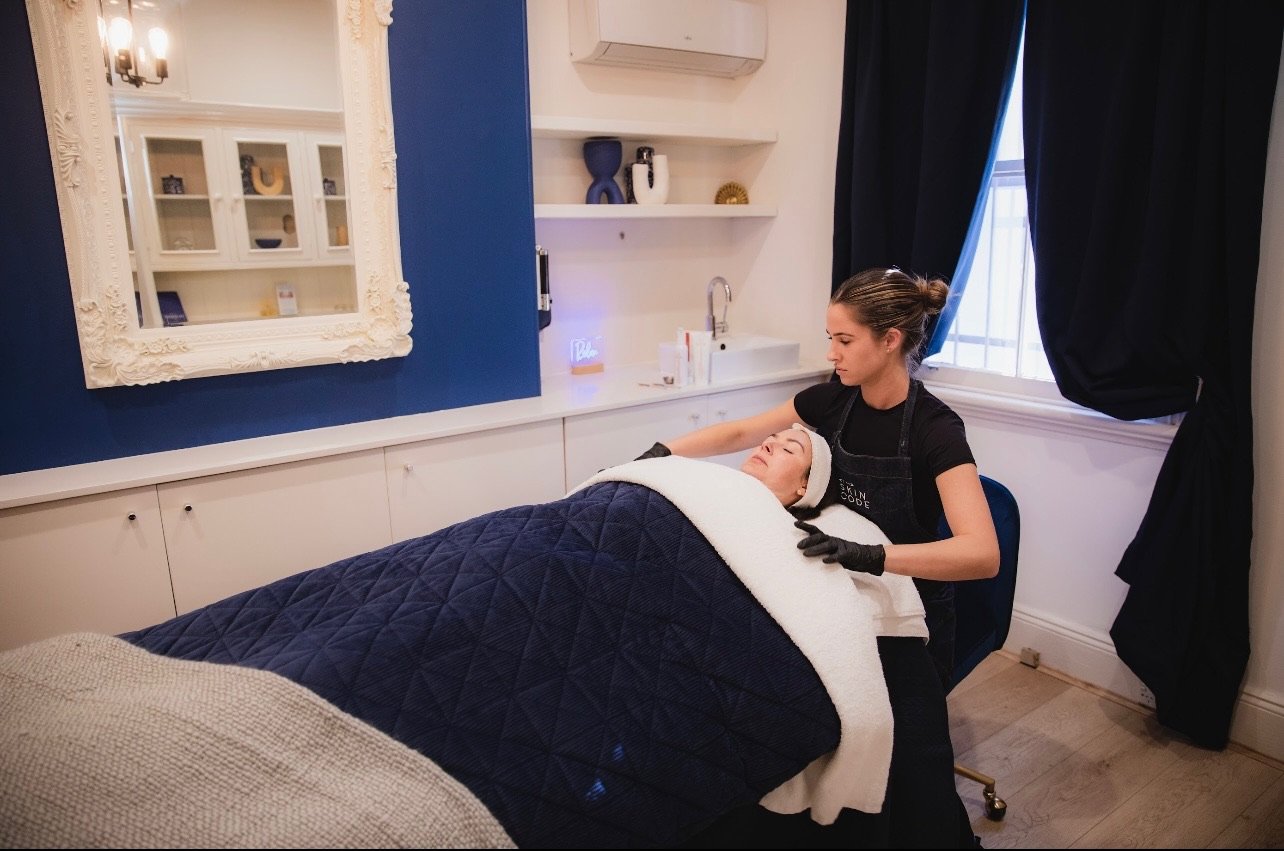
Professional therapist performing a facial treatment to a client in a tranquil, softly lit luxury environment.
Your appointment begins with a skin consultation assessing your skin type, concerns, and sensitivities. The facial typically lasts 60 to 90 minutes. The skin therapist applies cleansers, exfoliants, peels, serums, masks, and moisturiser.
Skin needling feels like controlled pressure and prickling; chemical peels may feel warm or mildly stinging, the skin therapist is constantly monitoring and adjusting based on the skins response.
The appointment experience
During the treatment, the skin therapist is constantly assessing. How is your skin responding to the peel? Does the needling depth feel right, or should it be adjusted? Should we add a booster serum or extend the treatment on a particular area? This real-time customisation is what separates a generic facial from a transformative one.
Most clients find the experience deeply relaxing. You're in expert hands, your skin is being cared for intensively, and there's nothing to do but receive. Many people fall asleep.
After the treatment, your skin will look flushed and feel warm. This is normal. You'll receive aftercare instructions: what products to use, what to avoid, when you can resume normal activities.
Downtime and recovery
Downtime varies by treatment intensity. An Essentials Facial or LED treatment has zero downtime. You can return to work, exercise, or social plans immediately.
A Transformation Facial typically has minimal downtime. You might see slight redness or mild flaking over the next 2 to 3 days, particularly if the peel was strong.
Skin needling can produce slight redness and minor swelling for 24 to 48 hours. Some clients see tiny red dots (the needle marks) for a day or two. This resolves quickly.
Chemical peels, particularly strong ones, can cause more visible flaking and redness for 3 to 5 days. This is expected. Your skin is literally renewing. Avoid sun, heat, and strenuous activity.
Questions to ask before a skin treatment
Before booking, ask: What modalities are included (peel strength, needling, LED wavelengths, serums)? Is treatment customised per visit? What's included in the price? How many treatments for real results? What's your experience with my specific concern? What's your aftercare protocol? Can I see before-and-after photos? Vague answers or overselling are red flags.
Is clinical skin treatment worth your investment
Clinical skin treatment is worth the cost if you have a skin concern that at-home products haven't resolved. For prevention, occasional professional facials (2 to 4 per year) are sufficient. For transformation, fading deep lines, clearing stubborn acne, evening pigmentation, a course of professional treatments is the only path that delivers. A Transformation Course ($885 for 3 treatments) can be a valuable investment for visible, lasting skin transformation.
![The Transformation Skin Journey Course - 3 Pack $813 [ $271 p/facial ]](https://cdn.shopify.com/s/files/1/0792/7096/9640/files/Transfrormation.webp?v=1730940744)
The Transformation Skin Journey Course - 3 Pack $885 [ $295 p/facial ]
At The Skin Code, we specialise in transformative clinical skin treatments tailored to your specific concerns and skin type. Whether you're addressing fine lines, acne, pigmentation, or texture, our Transformation and Indulgence Facial courses combine advanced modalities, Hydrafacial, skin needling, chemical peels, and LED therapy, to deliver results you can actually see. Book a consultation and let our skin therapists assess your skin and recommend the right course for your goals.
Frequently Asked Questions
Are clinical skin treatments worth the cost compared to at-home skincare?
Clinical skin treatments deliver results that at-home products cannot match because they use medical-grade active ingredients and professional application techniques. A single Transformation Facial at $329 addresses multiple skin concerns—ageing, acne, pigmentation—in one session using advanced peels, skin needling, and LED therapy. At-home skincare typically targets one concern at a time and requires months of consistent use. For visible anti-ageing results or treating resistant acne, clinical treatments compress what would take 6-12 months of home care into a few sessions.
How many sessions do I need to see real results from clinical skin treatments?
Most clients see visible improvement after 1-2 sessions, but lasting transformation requires a course of treatment. The Transformation Skin Journey Course includes 3 facials over 12 months at $295 per treatment, which allows your skin to build results progressively. For anti-ageing concerns, fine lines soften after the first treatment but continue improving over the course. Acne and pigmentation typically require a course of sessions spaced appropriately for optimal results. Your practitioner will recommend the right schedule based on your skin type and specific concerns.
How long do results from clinical skin treatments actually last?
Results from clinical skin treatments vary by treatment type and your skin maintenance routine. LED therapy and chemical peels can show results, and skin needling results build over time with proper aftercare and sunscreen use. Anti-ageing benefits are cumulative: the more sessions you complete, the longer results persist. Maintenance treatments every 4-6 weeks keep skin looking radiant and prevents regression. Without follow-up care, most visible benefits fade within 2-3 months.
What should I ask my practitioner before booking a clinical skin treatment?
Ask about their qualifications and experience treating your specific skin concern—whether it's rosacea, acne-prone skin, or pigmentation. Request before-and-after photos from clients with similar skin types. Clarify what downtime to expect and whether you can return to work the same day. Ask which treatment modalities will be used (for example, whether the Transformation Facial will include skin needling or advanced peels for your concern). Discuss realistic results for your skin type and how many sessions you'll likely need. Finally, ask about their aftercare protocol and what products they recommend to protect and maintain your results.
Is it worth paying more for a premium facial course instead of single treatments?
Treatment courses offer better value when you're committed to results. A single Transformation Facial costs $329, but the 3-pack course is $885 ($295 per facial), saving $102 overall. The Indulgence 3 x Course at $385 per facial includes extended areas (face, neck, décolletage) and advanced boosters like lymphatic drainage, which addresses ageing across your entire upper body. Courses are valid for 12 months, giving you flexibility to space treatments based on your schedule. If you're treating a specific concern like pre-wedding skin preparation or persistent acne, a course ensures consistency and allows your skin to respond optimally.